Policies promoting digital education credentials

3 common challenges and how to address them

Sopiko Beriashvili and  Michael Trucano

April 26, 2024


  • Policymakers, organizations, and practitioners around the world that are attempting to implement digital credentials and LERs at scale have identified three common challenges.
  • Countries do not often consider employers as key stakeholders in the process of developing and implementing policies surrounding digital credentials and LERs.
  • It is often unclear how digital credential and LER programs should be funded once they move beyond pilot stages, which are typically publicly funded.
  • Countries may need to make changes in existing legal frameworks in order to support the implementation of digital credential and LER initiatives.

Shutterstock/13_Phunkod

  • 9 min read

Education Plus Development

Education plus Development blog banner

Read more fromEducation Plus Development

Countries and education systems around the world are experimenting with innovative ways to enable learners to access additional education and career opportunities in support of their transition “from learning to earning.” One approach gaining traction involves the use of new types of digital education credentials and learning and employment records (LERs). Much of the research attention on the use of LERs has focused on the United States. Previous work at Brookings examined an emerging landscape of education and workforce innovations, with a focus on digital credentials and LERs. A follow-up report explored three case studies of initiatives supporting the introduction of digital education credentials in different contexts. Our recent blog post provided a lens through which leaders of LERs efforts in the United States might understand ongoing efforts in Europe to introduce digital education credentials and LERs. In this post, we’ll examine three common challenges being faced by efforts to introduce LERs at scale outside the United States, and the key questions that policymakers and practitioners in seven countries are asking as they seek to address them.

By briefly examining the landscape of related policy development processes in four European countries, as well as in three other Anglophone countries, we can highlight some common challenges associated with integrating the use of digital education credentials into existing national educational and workforce development programs. By doing so, we hope to contribute to the development of a common framework that can enable the sharing of perspectives and approaches across borders, so that solutions to such challenges can be discovered and implemented.

Surveying the landscape of LER policy

Micro-credentials in Europe

Across Europe, several countries are actively engaging in the implementation of “micro-credentials,” the term most commonly used across the continent, heavily focusing on higher education and vocational education and training. In June 2022, the Council of the European Union (EU) adopted a proposal on a European approach to micro-credentials to help develop new learning pathways within higher education and vocational education and training institutions. This helped to expand opportunities for lifelong learning and complementing other initiatives driving the transition toward digitally advanced and ecologically sustainable economies, often referred to as the “digital and green transitions.” Shortly thereafter, with financial support from the EU, the OECD launched a Micro-credential Implementation Project in August 2022 to assist Finland, Slovakia, Slovenia, and Spain in their efforts to develop national measures and outline practical approaches and steps that countries can take to deliver on the potential of micro-credentials. These are the results so far:

Finland: Responding to the European Union’s Council Recommendation on micro-credentials, the Ministry of Education and Culture (OKM) in Finland established a working group to develop and implement micro-credentials in its higher education system. Finland’s new initiative, the Finnish National Strategy for Continuous Learning in Higher Education 2030, serves as a clarifying document for the role of higher education institutions as part of the country’s Continuous Learning Reform that began in 2020. The use of micro-credentials, in accordance with EU guidelines, is one mechanism to support “continuous learning” and to acknowledge and “make better use of existing skills,” in response to the skills shortage.

Slovakia: In 2021, the government of Slovakia adopted a new Strategy for Lifelong Learning and Counselling for the years 2021-2030, which addresses the need to offer continuous learning opportunities to the individuals and the population experiencing skill shortages. Following the EU recommendation, Slovakia, like Finland, endorsed its National Reform Programme 2023. This plan includes the introduction of short courses and micro-credentials, primarily provided by higher education institutions. That said, the country’s new Lifelong Learning Act, which provides a new classification of the National Qualification System and establishes a legal framework for new micro-credentials, has remained in draft form since 2022.

Slovenia: Slovenian higher education institutions are currently in the process of developing pilot micro-credential programs as a component of the Reforming Higher Education for a Green and Resilient Transition to Society 5.0 initiative. The resolution on the National Programme of Higher Education to 2030 briefly addresses the strategy for integrating lifelong learning into the higher education sphere in Slovenia. That said, the necessary revision to the current Higher Education Act, which aims to establish a legal framework for incorporating lifelong learning as a fundamental mission of Slovenian higher education institutions, has not yet been drafted.

Spain: Under the EU’s Recovery and Resilience Facility, the government of Spain has committed to the development and adoption of micro-credentials within the Spanish higher education system. Royal Decree 822/2021(Section 8 of Article 37) grants universities the authorization to deliver continuing education courses through micro-credentials or micro-modules. The decree complements the Organic Law 2/2023 of the University System by embedding lifelong learning as the core function of the universities.

Other Anglophone countries

These efforts across Europe mirror similar developments in other parts of the world:

Australia: Australia is actively utilizing digital credentials to meet the diverse needs of learners and employers, particularly in higher education, vocational education, and industry. By closely aligning micro-credential knowledge and skills with industry demands, these credentials aim to empower learners in acquiring additional skills.

Canada: British Columbia has pioneered a digital education credential framework across its public post-secondary education system, paving the way for a more flexible and responsive approach to skills development, required to thrive in the future economy and workforce.

New Zealand: Micro-credentials are being offered by various institutions and organizations, including higher education institutions, private training establishments (PTEs), employers, and professional bodies, reflecting a collaborative effort to enhance learning opportunities.

Common challenges—and key related questions policymakers are attempting to answer to address them

High level analysis of developments in these seven countries highlights three common challenges experienced by many countries as they move toward implementation of policies promoting and enabling the use of digital education credentials and LERs.

Common challenge #1: Absence of employers as stakeholders in conversations

Many countries’ strategy documents and guidelines on digital education credentials and LERs emphasize lifelong learning opportunities within higher education and vocational education and training settings. However, they often don’t fully consider the role of some key stakeholders, like employers, who play a pivotal role in bridging the gap between formal education/training and the evolving demands for skills across both societies and labor markets. Research from the Aspen Institute on Employer Engagement in Learning and Employment Recordsunderscores the importance of involving employers in the design and development phases. Neglecting such early engagement may present challenges in bringing employers to the table once people seek to utilize newly acquired credentials as they move from learning to earning.

Key related questions policymakers are asking:

  • How to foster stronger collaboration with employers to ensure the relevance and effectiveness of digital education credential policies and projects?
  • How to address challenges that arise when employers have not been engaged at early stages of the development of digital education credential policies and projects?

Common challenge #2: Who pays for digital credentials and LERs?

Research from the OECD shows that public funding typically provides primary support in the initial or pilot stages of many digital credential efforts, often in the form of subsidies. As such initiatives scale, however, a blended mix of funding sources may need to be developed. Where learners are expected to bear related costs, in whole or in part, the economic value of such credentials may need to be very clear. The Finnish tradition of offering education either free of charge or at a nominal cost diminishes the appeal of fee-based micro-credentials for many learners, especially when their recognition in the labor market is not yet established. In countries such as Australia and Canada (Ontario), the government initially provided funding to cover the development and delivery expenses of micro-credentials. It is anticipated that supplementary financial backing will need to come from private sources, most likely through tuition fees. In Spain, where the micro-credential pilot is funded by the EU, learners are expected to contribute a portion of the expenses. Separate mechanisms are available to support individuals pursuing lifelong learning opportunities, which could include micro-credential programs. In Australia and Canada (Ontario), student grants and loan assistance are available to individuals participating in the funded micro-credential programs.

Key related questions policymakers are asking:

  • How should funding sources and mechanisms change as digital credential initiatives move from pilot stages to implementation at scale?
  • How can programs of study linked to digital credentials qualify for support under existing student grant and loan assistance programs?

Common challenge #3: Navigating legal bottlenecks

Changes to existing laws and regulations may be required in order to integrate micro-credentials in regional and national frameworks or systems initiated by national authorities or institutions. Countries such as Slovenia and Slovakia are grappling with necessary changes required in legal acts and decrees to support lifelong learning initiatives that integrate the use of digital credentials. In Slovenia, stakeholders are advocating for legislative changes to establish a fully functional regulatory system for micro-credentials. Slovakia is navigating the complexities of drafting legislation to differentiate between various types of micro-credentials and integrate them into existing education programs. As highlighted in a recent OECD report, while legal changes may introduce a solid basis for the integration of micro-credentials, higher education institutions require further guidance for implementation.

Key related questions policymakers are asking:

  • What strategies can countries employ to identify and implement the legal and regulatory changes needed to support the use of digital credentials?

Moving forward

Many countries are adopting the use of digital education credentials and learning and employment records (LERs) as part of larger processes to offer new opportunities to address skills shortages and advance lifelong learning. Along the way, nations such as Finland, Slovakia, Slovenia, Spain, Australia, Canada, and New Zealand have faced many common challenges, including employer engagement, funding uncertainties, and legal complexities. As is typically the case when introducing most any innovationthe devil is in the details. Moving forward, as more countries explore similar initiatives, and expand them, the documenting and sharing of related experiences across countries—the details—will become increasingly important. As conceptually appealing as the widespread adoption of digital educational credentials might be, however, they are no cure-all. The jury is still out on what impact such programs might have, and which groups will benefit— and which will not. Related research will be required in the coming years to answer such questions. The identification of key questions that policymakers are seeking to answer can provide a common framework to aid in the sharing of related knowledge and lessons across borders. More broadly, however, emerging experiences from the adoption of digital credential initiatives raise a larger, perhaps even fundamental provocation: If indeed digital education credentials are one answer to some of the deeper, systemic issues in the education and employment sectors, are we asking the right questions?

AUTHORS

SB 

Sopiko BeriashviliResearch Analyst – Global Economy and DevelopmentCenter for Universal Education

Michael TrucanoVisiting Fellow – Global Economy and DevelopmentCenter for Universal Education

What is the Socratic Method of Teaching?

In its simplest form, the Socratic method of teaching is a thought-provoking dialogue between an instructor and their students. It is based on the approach used by the philosopher Socrates, who was known to engage young minds in conversations designed to help define broad ideas, also exposing the complexities and ambiguities behind them.

Instead of giving information and facts, an instructor using the Socratic method of teaching asks students a series of open-ended questions (questions with more than a yes or no answer) about a specific topic or issue. In turn, the students can also pose questions of their own.

Instructors implementing a Socratic method of Teaching act more as facilitators or guides for classroom conversations rather than being providers of information. They compel students to consider why things are a certain way, also considering arguments for and against different viewpoints on a topic.

Socratic Method of Teaching Examples

To better understand what this method might look like within a college-level classroom setting, it can help to see it in action. Here are a few Socratic method of teaching examples:

• An instructor of a law class asks a student to summarize the facts of a specific court case. The student is then asked if they agree or disagree with the court’s findings and why. The instructor may then change some of the facts of the case, asking the student to explain whether they still hold the same position. Different sides of the case are explored, as well as the potential reasonings behind them.

• An instructor of a social work class has the students read an article about substance abuse in certain populations. A student is asked to provide a summary of the article. The instructor then asks about the importance of this topic. This leads to questions about whether the article changed the student’s views or their opinion on the subject.

When employing the Socratic method of teaching, the instructor may go through similar question sequences with multiple students, providing a wider range of explanations and potential points of view.

Socratic Method Benefits

The Socratic method of teaching encourages students to explore their thoughts and beliefs, also considering how these thoughts and beliefs may contribute to their assumptions about the topic at hand. This method also helps foster critical thinking, enabling students to reach their own conclusions based on self-analysis of the information versus just accepting what they are told.

One study involving undergraduate business students confirms that the Socratic method of teaching helps improve a student’s critical thinking skills. Another study also found positive findings, this time suggesting that this method can be beneficial for improving reading comprehension by placing more attention on critical thinking and the ability to see the world from a different point of view.

An additional benefit of the Socratic method is that it keeps students engaged. If you’ve ever been in a classroom with a teacher who does nothing more than spew facts for you to write down, you know how unappealing this can be. Being in a classroom where the Socratic Method of teaching is employed provides a whole different feel. You are actively engaged in the conversation, contributing to the topic based on your experiences and opinions while also learning from other students.

How to Get the Most from a Socratic Method of Teaching

If you are in a classroom in which the instructor uses a Socratic method of teaching, there are a few things you can do to get the most out of this experience. This includes:

• Coming to class prepared so you can participate intelligently in the discussion.

• Thinking about the topic in advance, considering your opinions or the factors you feel might be at play.

• Being willing to speak up and share your thoughts so others can learn from your interpretations, which may involve working to overcome your fear of public speaking.

• Becoming a good listener when the instructor is engaging with other students, seeking to learn from their interactions.

In the end, the Socratic method of teaching is designed to help students gain a better understanding of a topic, including the complexities behind it. It also aims

Saint Leo university.

Is English becoming the global language?

Now I’m more than ever even post pandemic, yet many may argue that it is not over yet, and we are far from it , where has it left our children globally. When you work in education over three decades are able to see throughout the world the differences between our pre- new normal it is frightening to parents, teachers administrators and global leaders in the education industry.

Higher education numbers are going down. Students are barely finishing equivalent of high school education, and either leaving or attaching themselves to short term vocational studies to be trained for specific jobs or tasks that can earn them a living.

Where are we failing tutors teachers who can help carry the weight? Parents have to work in an economy where their currency can barely carry a family with only one or two children wages are low and stress is high.

There is a growth in the tutor industry which allows students to get additional help beyond their public schooling. But yet they are still not meeting standards be in the US or abroad.

As a lifelong educator, teaching to diverse students from special needs to students who have just fallen through the cracks. We have to gather together the strength that we have within Academia to try and pull together to help what was coined as “no child left behind”. we saw where that left us in the US when that was brought to Capitol Hill

Now that the pandemic has unified all our countries all the children of the world have been impacted we have to create a global army academics, who cannot only help pull them up from the youngest age to higher education to help young learners have a vision, have goals and see them to fruition.

As an academic citizen of the world, I can see the numbers falling. I can see the brain drain of students who have an excellent chance at raising the standards in the countries that they have grown and their generations before. But brain drain has caused many to leave Educate abroad and not return.

What we are left with now is to utilize the resources that surround the areas. The countries in the children that now need help in specific subjects where there are lack of instructors qualified. English word was once the most global language in the world many young learners have no idea how to even converse

Helping English Language Learners Decipher Tough Texts

Teachers can help ELL students read at higher levels by emphasizing sentence structure and meaning making.

By Penelope Jennewein

March 14, 2024

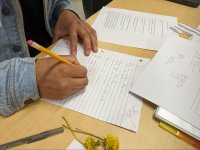
Photo of student writing on paper in classroom

Courtesy of Penelope Jennewein

Helping newcomer students who have interrupted educational backgrounds read high-level English texts is an enormous challenge for classroom teachers. How do you create meaning from a huge block of text when students are struggling with basic phonics? How do you engender understanding of an English text when students are emerging English language learners (ELLs)? 

This school year I taught a class of all emerging English high school learners (generally level 1 ELLs), and I noticed that their strategy of dealing with an English text was to take out their cellphones and use Google Lens to automatically translate text in the picture. Although I didn’t want to fully discourage student use of this tool, from a teaching perspective, I didn’t want them to rely on this as their only tool. As a language learner myself, I know that simply translating a block of text is not how I learn a new language. The process of figuring out meaning helps cement new information into my brain.

The challenge is how to encourage students to engage with text in a way that maintains student engagement throughout the lesson, while making the information comprehensible. This is the routine I used.

Start of newsletter promotion.

top view of a phone showing the Edutopia tech newsletter

Our Edtech Newsletter Is Here

Supercharge your pedagogy with The Wired Classroom! Our monthly coverage will show you how to save time and drive deeper learning with tech.Sign me up

End of newsletter promotion.

PARTNER READING ROUTINE

I created a collaborative protocol that enabled students to work together to make meaning of the new language they were encountering. After building background, introducing key vocabulary, and chunking the text into manageable parts for pairs of students, we would begin with the partner reading routine. This is the five-step process: 

1. Teacher reads, students listen.Students are able to hear fluency from an English speaker.

2. Students read. Students work in pairs and switch off reading, following along as their partner reads. 

3. Students read again. Students read their chunk of text a second time because the repeated reading allows for increased fluency and comprehension. 

4. Students determine what it means. Students comb the text for at least three subject and verb pairs, marking them with our annotation technique. 

Then, they speak to each other about what it means. I provide sentence frames, and we spend time modeling how to have an academic discussion in English. If possible, I strategically pair students who can speak to each other in their home language, since allowing students time to process in their home language increases both comprehension and English fluency.

In this step, students translate single words or short phrases with an online or physical word-to-word dictionary. This is an opportunity for students to develop dictionary skills, as long as the bulk of the time is not spent searching for the word. At first I observed students using their phones to translate large blocks of text, but as they gained more experience with the routine, students began to trust the process and only translated words they really did not know. 

5. Write what it means. The last step is taking what they understood it to mean in their home language and putting it into English. Students are expected to write a short sentence with a “who or what,” a “do,” and a short object phrase that describes what, where, when, or how. At the beginning of the year, I found students going right to Google Translate, but as they established trust in the process, they saw what they could do without relying on translation. Later on or the following day, I might use the sentences that students generated as a lesson in grammar or as the prompt for a class discussion on meaning. 

BREAKING THE CODE OF THE ENGLISH LANGUAGE

After a few months of using this strategy, students were constructing meaning from complex texts orally and in writing. The basis of the protocol is a strong foundation in basic English sentence structure. Throughout the year I explicitly, routinely, and systematically teach that every sentence has a subject and a verb. We combined the word subject with who or what. And a verb is what the who or what does. We started with simple, bare-bones sentences (e.g., “The tools lean” or “The dogs bark”).

Following the structure of the now-out-of-print curriculum Framing Your Thoughts and the work of William Van Cleave, I add on more pieces of the sentence—pronouns, adverbs, prepositions (which is the order laid out in most curricula). Slowly we begin moving into more complex sentence patterns, such as sentences that start with dependent clauses. Although teaching grammar in a vacuum is generally not considered to be best practice, I believe that when taught in the context of language learning and deciphering text, it gives students the tools they need to construct meaning. 

This strategy showcases the amazing things that newcomers to English are capable of, and it enabled them to access much higher level text. The routine can be adapted in many different ways. For example, for classes that need more support, student pairs could wait for teacher direction after each step. Occasionally, I had certain students use a list and check off each task as they went. 

In classrooms where there is such a gap between the content and what students are able to access on their own, it can be hard to find ways for students to take on the majority of academic tasks. The routine and the foundation in sentence structure enabled students to take on significant intellectual work while also hitting all four language domains. Following strong routines, separating tasks into manageable parts, and breaking down the code of the English language are all useful tools to help students succeed.

We Have First-Graders Who Can’t Sing the Alphabet Song’: Pandemic Continues to Push Young Readers Off Track, New Data Shows

ASCD By LINDA JACOBSON | February 16, 2022 Young children learning to read — especially Black and Hispanic students — are in need of significant …

We Have First-Graders Who Can’t Sing the Alphabet Song’: Pandemic Continues to Push Young Readers Off Track, New Data Shows

The global education system….. We have to look back to where we began, ….but where are we going?

Sophia Epitropoulos EdS, M.Ed EDD ABD

Education Specialist

December 17,2023

Wherever I am in the world, I am always on the lookout for the education system in place. Most especially here in Greece, the birth of modern education, logic, medicine… not just Windex !!

As we evolve into a new world order or “normal” as they call it. This is a wonderful resource to understand the education system here.

I entered sometime back the University of Athens Online, lifelong learning program offered to those who want to continue studies and have completed prior degrees. Not just to understand early philosophy but laying out a wonderful foundation to understand the emphasis on the current use of the modern Socratic method, in all areas of education. Not only here in Greece , but globally, and especially now in the US.

Many do not understand the depth and the pride that Greece has in its early philosophers in the development of such critical areas A country not just known for its sports. Of which we know is of pride as well countrywide, but for all the advancements of what has propelled globally countries to develop new technology, new education methods, and of course, advancements in the health field.

We can look at the beginning as the starts from which the seed planted landed in early and modern schools as educational tools available to students.

As many proud Greeks, including this one … I especially pay attention to the education system here, not just for years but today (especially post Covid ) and how it has been enticed by schools outside of the Greek education system in post, secondary education for our Greek students to study abroad. This has led to an increase over the years in not only those who study here in Greece, but those who leave and do not return, taking their education and skills to other countries, globally. We often hear and read in education publications about what is termed as “brain drain.”

Simply put, it is that these minds do not return to apply what they have learned to infuse this knowledge and practice into the country that raised them and goes back generations in their historical roots.

Brain Drain

No country should be subjected to “brain drain” it has been a crisis here for many years in many countries. Children as young adults leave to be educated abroad not to return to bring that learning here and pay it forward to the next generations. There is a great emphasis, and should be in athletics, which are so important. Especially in the age of technology where children are glued to screens of smart phones, iPads, computer screens, and rarely even make it outside, but a few times a day to get proper exercise, if nothing else.

Look for good resources!

This is a great website to start. Even if you’re not an educator, our children even special needs every child in every part of the world has needs and without nurturing every part of them, we lose them in many ways. Of course, I would love to just rework many and much of this education system. There isn’t anywhere I go that I don’t look at the curriculum to see if it has been adapted, and adjusted to where we are today and applicable as well as inclusive of all children.

We want healthy, athletic and smart children, but most of all we want them to be everything they dream of, no matter what it takes. We want them also as a country, especially here in Greece for them to return and help engage, and inspire a new generation behind them.

Full bright scholarships are a wonderful resource globally for those in the upper post secondary graduate and research fields but also, they offered so many resources for students to explore different field of study. Let’s work on, not leaving any children behind anywhere we see where the world is headed right now. It seems grim, but it is not the time to drop the ball.

https://www.fulbright.gr/en/study-in-greece/the-greek-educational-system

Sophia Epitropoulos, M.Ed, Ed.s is a postgraduate Education Specialist working with children K-12, as well as higher education. A global language art Specialist for children with learning disabilities , using art as a therapy for healing, and an instructional designer. currently located in Athens, Greece

Exploring the Pros and Cons of Montessori EducationBy Hannah Meinke on 11/04/2019

What do Jeff Bezos and preschoolers have in common? Maybe not much at a surface level, but in 2018, the e-commerce king pledged $1 billion to fund low-income Montessori preschools. You may not have known it, but along with many of the tech giants who founded Google® and famous athletes, musicians, and activists, Bezos himself was Montessori educated.

Hearing about this eye-catching donation and some of the prominent figures educated in a Montessori program might have you itching to learn more about what Montessori is and the potential pros and cons to taking this educational approach. Read on to learn more about this unique style of educational instruction.

What is the Montessori Method?
The Montessori Method was developed by Dr. Maria Montessori in the early 1900s. It’s a specific child-centered method of education that involves child-led activities (referred to as “work”), classrooms with children of varying ages and teachers who encourage independence among their pupils.

Dr. Montessori believed that children learn better when they’re choosing what to learn, and that philosophy is present in Montessori classrooms today. A Montessori classroom likely looks different than what you’re used to. Things that make it unique include:

Various activity stations for children to choose from throughout the day.
Teachers moving from group to group instead of standing at the front of the classroom.
A nontraditional grading system.
A focus on the whole student—social, emotional, intellectual and physical development are all considered.
Like with any instructional method, some teachers and parents love the approach, while others aren’t as enamored. Read on to learn more about some of the potential pros and cons of Montessori education.

The pros of Montessori education
If you ever talk to a Montessori educator, you are likely to hear a cascade of praise for the Montessori Method. Systems of education tend to inspire a real passion in the teachers who use them. But what, specifically, are the pros of a Montessori education?

An emphasis on hands-on independent learning
Montessori classrooms are somewhat famous for their beauty. Lots of natural light and space are common priorities in the classroom design. This is all done for a reason. “Creating a beautiful and accessible environment is of paramount importance, as children direct their own learning with the help of meticulously designed learning aids,” says Karen Ricks, who founded an international Montessori school in Japan.

“These materials lead young learners to the understanding of complex vocabulary and the discovery of abstract ideas through the hands-on use of concrete objects fashioned for just such a purpose,” Ricks explains.

“The best thing about a Montessori environment is that it allows for children to work, develop and learn at their own individual pace,” says Anitra Jackson, Montessori educator and writer of Chronicles of a Momtessorian. “Children are exposed to lessons, activities and materials that build upon their skill set—they progress in their development as an individual.”

What does this look like? Well, something like a giant playroom-meets-workshop. “My favorite aspect of a Montessori classroom lies within the sensory-based materials we use with our students, particularly the geometric solids, sandpaper letters and the colored bead stair used for arithmetic,” says Melissa Stepien, a teacher at Sunnyside Micro-School.

“These independently-used materials provide students with the opportunity to develop their concentration and coordination in addition to more traditional academic learning,” Stepien says.

Enhanced social interaction
Have you ever noticed the way children become fascinated by what other children are doing? Montessori capitalizes on that by grouping children of different ages together in the same learning environments. Stepien says most Montessori classrooms are mixed-age and intended to foster peer-to-peer learning. This arrangement can naturally lead to growth that might not occur in a more uniformly-aged classroom.

“These mixed-aged groups allow for children to learn from one another, teach one another and develop life skills such as inclusion and acceptance,” Jackson says.

Independence is a mainstay
“I valued the sense of confidence and creative freedom you develop,” says Lexi Montgomery, Montessori alum and owner at Darling Web Design. “I think a Montessori background is better for developing an entrepreneurial skillset.” Since much of the learning process is self-directed, children can gain a sense of independence and confidence in their abilities much faster than in a traditional school setting.

“Students who experience a Montessori classroom tend to be more able to manage themselves and think independently,” Stepien says.

A cultivated love for learning
This educational philosophy strives to encourage a love for learning. “I think the biggest long-term impact I have seen is that Montessorians remain perpetually curious about the people and the world around them, seeing learning as an enjoyable life-long process rather than a burden that ends when a school bell rings,” Ricks says.

This particular benefit can stay with children their entire lives and become a propelling force through secondary education, a career, job training—or even just in the experiences they have and the people they encounter.

“In my experience, they have a desire and an ability to connect with a variety of people and ideas in many different situations and contexts,” Ricks says.

Inclusive of special needs
Maria Montessori’s vision for education included children with special needs from the very beginning. Not only did she study intellectual and developmental disabilities, but she was the co-director of an institute for special education teachers. It was with this background that she started her first “Casa dei Bambini” (Children’s House) for disenfranchised children in Rome in 1907. Many of the tenets of Montessori education serve students with special needs well.

Because children are grouped with others of different ages and have the same teacher for three years at a time, students with special needs tend to have less pressure to keep up with their peers and more freedom to learn and grow at their own pace. The classroom continuity can also help students with special needs form close connections within their classroom, making for a safe and stable environment in which to learn.

Montessori’s “follow the child” philosophy allows for all children—not just those with special needs—to receive an individualized education. A Montessori instructor’s lesson plan may have each child’s name on it with different goals and ideas for their unique learning style. This especially helps students with special needs to learn at their own pace.

The cons of Montessori education
Of course, this is not to say that every experience in Montessori will be a good one. On one side, teachers, classmates and school administration can seriously impact your experience for the better. And on the other side, there are some aspects of the Montessori culture that can cause issues for some.

It can be expensive
It is hard for Montessori schools to keep their prices low. “The acquisition of so many durable and high-quality learning materials, as well as the lengthy and in-depth training in the use of such items for young children is an expensive undertaking,” Ricks says. “Which is why most fully implemented Montessori programs are expensive.”

While organizations are attempting to combat the expense on behalf of students—such as the foundation created by Bezos—there aren’t many options for teachers in their continuing Montessori education or certification. Ricks says that she “would love to see a Montessori education that is accessible to all adults who wish to ‘follow the child’ and to all children, regardless of their parents’ financial status.”

It’s not accessible to everyone
For some, Montessori education has gone hand in hand with being white and privileged. While this is nowhere near Maria’s original vision for Montessori, it is unfortunately the norm. Because this education philosophy flips traditional public-school curriculum on its head, most Montessori programs are private, tuition-charging and admissions-regulating. This makes it disproportionably difficult for low-income, inner-city students of color to attend such schools.

There are, however, some Montessori charter schools that are more accessible. The National Center for Montessori in the Public Sector reports that out of the 5,000 Montessori schools in the U.S., there are about 500 public programs.1 They are typically located in more diverse areas and federally-funded, removing the tuition barrier.

Curriculum may be too loose for some
While “following the child” should not be interpreted as “let kids do whatever they want,”it is still a less-structured curriculum than what you might find in a more common approach.

It is up to the teacher and assistant to make sure children progress on pace. Ideally, this give and take can work well. But it can also create room for some subjects to fall by the wayside.

“I would change the looseness of the curriculum,” Montgomery says, looking back on her own experience. “I was very under-prepared for math and science classes and over-prepared for language and arts classes.”

Independence isn’t everything
Montessori is strong in fostering a sense of independence and self-guided work. But as Montgomery points out, employment situations aren’t always like that. The entrepreneurial mindset that can be so valuable can also make it hard for students to collaborate in teams and work under a rigid authority.

“Montessori school teaches you to think on your own terms, and the workforce is a more team-oriented environment,” Montgomery says.

“Students could use more support on how to collaborate,” Stepien says. “Collaboration is not a student practice that is addressed well in Montessori curriculum.” Since collaboration is such a prized skill in today’s world, some Montessori schools might definitely push their emphasis in this area.

The open-ended structure of the classroom can be intimidating for some
Children tend to like routine and structure. Even the physical barriers of desks lined up in a row can be a comfort to certain students. Montessori classrooms are built to allow movement and change and the teachers tend to guide more than directly instruct.

While this is probably not an insurmountable obstacle, it’s definitely something to bear in mind. The hierarchy of traditional classrooms allows less freedom to the students, but it can also ensure a class environment that feels ordered, safe and routine.

Should you be a Montessori teacher?
If these pros and cons of Montessori education are really exciting you, you might want to look into becoming a Montessori teacher. But before you dive in, Ricks says it’s important to do your homework on the Montessori Method.

“There is no trademark on the name, and there are many schools calling themselves ‘Montessori’ that do not follow the true methods,” Ricks says.

“While I personally believe that Montessori is for every child, I also firmly believe it is not necessarily for every adult,” Ricks says. “In order to truly ‘follow the child,’ one must first have faith in the child and the child’s natural desire to learn.” Ricks advises every potential Montessori educator to examine themselves to see if these beliefs hold true.

If you decide you want to employ the Montessori Method, getting educated is your first step. After that, you can decide if you want to teach at an authentic Montessori school or if you just want to incorporate some Montessori principles in your teaching. Learn more about becoming a Montessori teacher or earning a Montessori credential on the American Montessori Society’s website.

1National Center for Montessori in the Public Sector [accessed October, 2019] https://www.public-montessori.org/montessori/

Editor’s note: This article was originally published in 2014 and has since been updated. Insight from Ricks, Jackson, Stepien and Montgomery remain from the original.

As Nation’s Report Card Resumes for First Time Since Pandemic, Federal Testing Chief Admits She’s ‘A Little Nervous’ about Results

….note…Sadly, the state of education is in decline. No surprise. We are losing control and the train is off the rails. The educators can only do so much. Pointing fingers in every direction doesn’t help. Just like the sign I used to have in my office chairing my department..” don’t bring me a problem Dash unless you have a solution” , otherwise we don’t have any way of creating a solution. This article is very enlightening!t

By LINDA JACOBSON | March 28, 2022

Almost 600,000 U.S. fourth- and eighth-graders are currently taking national reading and math tests for the first time since the pandemic began.

The prospect makes the federal official in charge of measuring student progress a bit anxious. 

“The likelihood that the scores would be anything but down is pretty small,” said Peggy Carr, commissioner of the National Center for Education Statistics. 

While performance among the lowest-scoring fourth- and eighth-graders on the National Assessment of Educational Progress was falling well before the pandemic, Carr predicted, “It’s more than likely we’re going to see the bottom drop even more.”

Stay informed.
Invest in independent journalism. And help The 74 make an impact.Help us reach our Spring Campaign membership goal.DONATE NOW!

Known as the Nation’s Report Card and a chief “barometer” of educational achievement in the U.S., the congressionally-mandated NAEP is the only assessment with results broken down by gender, race and socioeconomic status that can be compared across all 50 states. As such, it is a major gauge of achievement gaps that are likely to have grown larger since COVID’s arrival.

Carr’s predecessor, James “Lynn” Woodworth, described this year’s administration as “the most important NAEP assessment that’s ever been done in the history of this country.” In a wide-ranging interview with The 74, Carr fleshed out why, explaining that the pandemic had added layers of “noise” that could make results harder to interpret.

RELATED700 Days Since Lockdown

‘True change’

Even the most superficial alteration in a student’s testing experience can throw off their performance. In the mid-1980s, researchers determined that a change in the color of the ink on the test booklets contributed to an otherwise unexplained drop in reading performance for 9- and 17-year-olds. In 2002, the mistake was accidentally repeated with a random sample of students, and again, scores dropped. 

But the pandemic has exploded the universe of possible variables: The sample of test-takers includes masked and unmasked students, as well as smaller groups. Social distancing and other changes in the environment could also affect student performance.

“It makes me a little nervous about what we’re going to see, and how I’m going to be able to separate out what is noise and what is true change in students’ performance,” she said. 

At the same time, collecting those results has been far from easy. From staff quitting due to illness to schools rescheduling because of students in quarantine, this round of testing is unlike anything the center has faced in the past. 

“I’m getting notices every day that people are quitting or people have … caught COVID in the schools,” Carr said. 

In December, there were 3,560 NAEP staff members in the field. More than 850 have quit, with over half of those leaving in December and January as Omicron started to spread, according to NCES. 

Because of COVID’s lingering interference, Carr said she was pleasantly surprised schools haven’t pulled out of the assessment. Only one district, Fresno Unified in California, opted not to participate in the Trial Urban District Assessment, which provides results for more than two dozen districts nationwide. 

Nonetheless, state and district chiefs have already expressed concern about whether Carr can guarantee the validity of the results.

“They said, ‘Peggy, I’ve got 900 vacancies. I have people who normally teach art teaching some academic subject,’” she said. 

To the doubters, she emphasized that this year’s tests include the same items used in 2019, which will further give the public a “solid trend line” through the pandemic years, she said. 

NAEP, she stressed, is “still the standard by which other large-scale assessments judge themselves, and even in the context of COVID that has not changed.”

But because of the impact of the pandemic, it might seem as if this year’s results are setting a new “baseline,” Carr said. A baseline, which technically refers to official changes in the test, is the starting point researchers and policymakers use to track student performance over time.

“It’s a new day in many ways,” Carr said. “How tests are being administered, how students are being taught and how they learn in schools today is a little different than it was before COVID.” 

Despite those challenges, NCES’s responsibility is to maintain the public’s trust in NAEP as an accurate measure, said Andrew Ho, an education professor at Harvard University and a former member of the National Assessment Governing Board, which sets policy for NAEP.

Carr must help parents and educators understand how the pandemic has affected fourth- and eighth-graders’ math and reading achievement, he said. “It’s not a new baseline if we do our job right,” he said. “It is a decline.”

He and Carr said the urban district results will be especially valuable when viewed against the backdrop of school closures at those sites. 

“There are always policy differences; they just haven’t been so confounded with historic health issues,” Ho said, adding that it’s inevitable the results will become fodder for political arguments over how leaders responded to the pandemic. “Everyone likes to attach a policy story to NAEP results.”

RELATEDOne Fate, Two Fates. Red States, Blue States: New Data Reveal a 432-Hour In-Person Learning Gap Produced by the Politics of Pandemic Schooling

In addition to the reading and math tests, which were delayed a year because of school closures, NCES is testing eighth graders in civics and history and 9-year-olds as part of its long-term trend study. Nine-year-olds were also tested in 2019, which will allow NCES to provide pre- and post-pandemic results. Data from three years ago showed stagnant performance in both reading and math, except for girls, whose math scores dropped five points. Now researchers will be able to see how students in that age group, who were in first or second grade when schools shifted to remote learning, are performing. Next year, 13-year-olds will be assessed.

bipartisan bill in the Senate, introduced this month, proposes that NCES add a new component to measure the long-term impact of COVID on a representative sample of students.

RELATEDAcademic Mismatch: Students Earned Record-High GPAs as Scores Lagged on Achievement Tests. Here’s What the New Federal Data Could Mean

It could be much harder, however, to see how U.S. students fared during the pandemic compared to their peers in other countries. While states and districts generally participate in all non-mandated NAEP tests, such as those in history, economics and technology, Carr struggles to get an adequate sample — 350 schools — for the Program for International Student Assessment and other global comparisons. 

School leaders are bombarded with requests to participate in surveys and an optional assessment can feel like one more burden. When Betsy DeVos was education secretary, Carr asked her to recruit schools for the international assessment. Michael Casserly, who led the Council of the Great City Schools and pushed for the urban assessment results, also helped.

“When Betsy DeVos was here, we had her calling schools, and we got Mike Casserly, who’s a good friend of mine, calling schools and we barely made it,” Carr said. “It’s a hard sell. I’ve got to figure out another way to develop a relationship with the stakeholders on the ground and make it worth their while to participate.”

Cloud-based tests and AI scoring 

As Carr prepares to analyze this year’s NAEP data, she’s also overseeing a modernization of the program, which has been “fast-tracked” by the pandemic, she wrote in a recent blog post, co-authored with Lesley Muldoon, executive director of the assessment’s governing board.

Future tests will be cloud-based and downloaded to districts’ own devices. And beginning in 2024, NCES will no longer hire 3,500 to 4,000 administrators to deliver devices with the assessment to schools. That model, which prevented the center from conducting mandated tests in 2021, typically costs about $62 million. 

While some field staff will still be on site, using local administrators could save $22 million, according to a report released last week.

Also in 2024, NCES will begin using artificial intelligence to score students’ essays. In January, the center announced four winners of a competition who showed AI can score an essay with 88% accuracy compared to trained individuals, Carr said.

“It may be good enough with a little bit of tweaking,” she said, adding that the center will still have human scorers in 2024 to remain “scientifically defensible.”

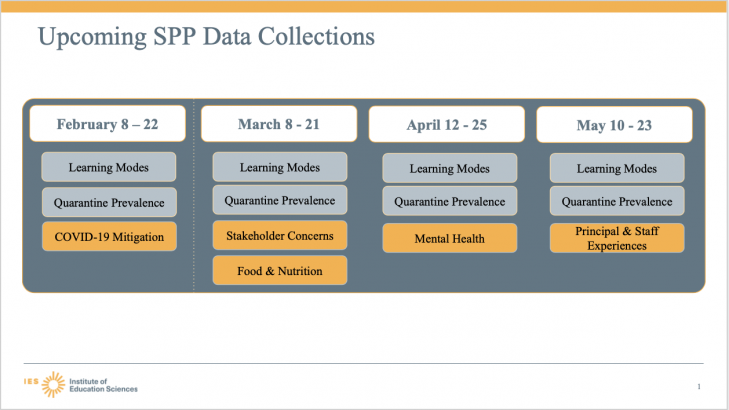
The center will also continue running its monthly School Pulse Panel — the result of an early Biden administration executive order to produce data on the impact of the pandemic. The survey tracks the percentages of students in in-person, hybrid and remote learning and has expanded to add questions on staff vacancies, quarantines and mental health. 

The School Pulse Panel survey will run through May with questions on quarantines, school nutrition and mental health. (Institute for Education Sciences)

The project has pushed the center toward a quicker turnaround — something the governing board and state and local leaders would like to see with NAEP as well. 

“If I don’t have to put together the full-blown report card with all the bells and whistles, maybe I can get it out faster,” Carr said. “But I’m not going to cut short the statistical analysis that I need to make sure we can stand behind the data. I’ll put asterisks on it. I’ll caveat it, and then … whatever it says, I’m going to report it.”

We Have First-Graders Who Can’t Sing the Alphabet Song’: Pandemic Continues to Push Young Readers Off Track, New Data Shows

ASCD By LINDA JACOBSON | February 16, 2022

Young children learning to read — especially Black and Hispanic students — are in need of significant support nearly two years after the pandemic disrupted their transition into school, according to new assessment results.

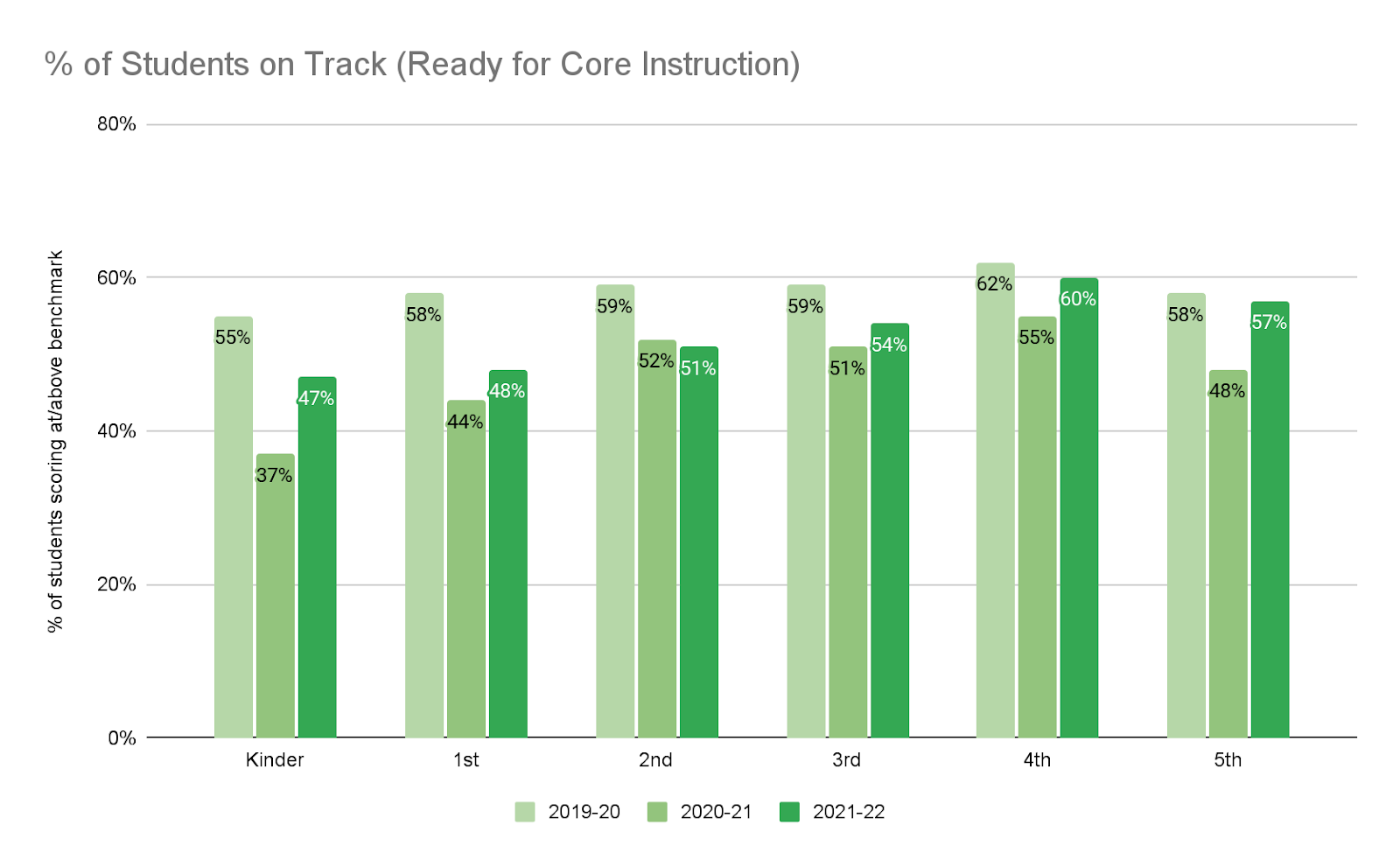
Mid-year data from Amplify, a curriculum and assessment provider, shows that while the so-called “COVID cohort” of students in kindergarten, first and second grade are making progress, they haven’t caught up to where students in those grade levels were performing before schools shut down in March 2020. 

At this point in the 2019-20 school year, for example, 58 percent of first-graders were scoring at or above the grade-level goals. This time last year — when only about half of the nation’s schools were offering full-time, in-person learning — 44 percent of first-graders were on track. Now 48 percent are reaching the benchmark.

Results from fourth- and fifth-graders, however, show greater recovery, with the rates of students meeting benchmarks nearly back to the same level they were in the winter of the 2019-20 school year.

“Learning disruptions had a significant impact on our literacy outcomes,” said Susan Lambert, chief academic officer of elementary humanities at Amplify. She added that this year’s quarantines and short-term closures have likely contributed to the slow progress. “For the youngest learners to go to school for two or three days and then be out for 10 — it’s not just picking up where you left off; it’s actually starting all over again.”

The percentage of students in K-3 off track in reading is still higher than it was before the pandemic, but reading performance in grades four and five is back to where it was before schools closed in March 2020. (Amplify)

Whether they skipped kindergarten and pre-K or spent much of their school years learning over Zoom, students in the primary grades didn’t have a normal introduction to reading. Educators note that less time to build vocabulary skills through socializing and disparities in children’s home lives — some had parents who read to them every night while others missed out — have contributed to the gaps. But reading experts and tutoring providers say they’re seeing students make strong gains with one-on-one support. The pandemic, they add, has only brought greater awareness to a persistent challenge. RELATED700 Days Since Lockdown

“What has happened in the past couple years is more dramatic, but it’s not anything new for us who work in early literacy. Children have been struggling with reading for years and years,” said Kate Bauer-Jones, who runs Future Forward, an early literacy and family engagement program that works with districts in Alabama, Georgia and Wisconsin. The program recently received a $14 million grant from the U.S. Department of Education to expand to eight more states.

State-level efforts to improve reading instruction continue to spread, but Kymyona Burk, senior policy fellow for early literacy at the Foundation for Excellence in Education, said it can take two to three years before districts start to see gains. Schools, she said, also need to identify children who might have learning disabilities and provide parents with materials to use at home.RELATEDEarly Reading Skills See a Rebound From In-Person Learning, But Racial Gaps Have Grown Wider, Tests Show

She added that even when children returned to in-person learning, social distancing from peers and teachers still got in the way of listening and speaking, which contribute to early reading skills. 

The Amplify data also shows racial disparities, with Black and Hispanic students in K-2 not making as strong of a comeback as white students and gaps growing larger than they were before the pandemic.

Amplify assesses students with DIBELS, or Dynamic Indicators of Basic Early Literacy Skills — a widely used measure of early reading development. The results are drawn from a national sample of 400,000 K-5 students from 1,300 schools in 37 states, allowing the researchers to compare pre-pandemic and current performance. While the schools in the research sample are more likely to be in large urban areas — and spent a longer period on remote or hybrid learning — Paul Gazzerro, Amplify’s director of data analytics, said he’s seeing similar performance across all schools using its assessment, which he described as “sobering.”

DIBELS itself doesn’t involve a lot of reading, but helps to predict how well children develop literacy skills by testing how fast and accurately they identify words, explained Rachael Gabriel, an associate professor of literacy education at the University of Connecticut.

She agreed that racial gaps in the early grades are widening and that “students are coming into K and 1 with different sets of skills” than before the pandemic. But at the same time, schools are “doubling down” on remediation and using both virtual and in-person tutoring programs to help students catch up.

She urged parents without access to tutoring to keep reading and writing with their children.

“This doesn’t solve the problem,” she said, “but it’s a protective factor that makes students more resilient” when instruction doesn’t match their needs.RELATEDAs Schools Push for More Tutoring, New Research Points to Its Effectiveness — and the Challenge of Scaling it To Combat Learning Loss

Future Forward’s tutors are seeing those needs up close.

“We have first-graders who can’t sing the alphabet song,” Bauer-Jones said. “We’re seeing first graders coming in with no familiarity with text.”

During remote learning, her tutors mailed magnetic letters, books and literacy materials to children’s homes. But even if students consistently participated in Zoom sessions, those were “in no way, shape or form equivalent to in-person learning,” she said. 

In fact, she added, tutors don’t see much difference in skills between young children who skipped pre-K or kindergarten in 2020-21 completely and those who spent much of that year in virtual learning.RELATEDReport: With Omicron, Math App Zearn Reveals a Troubling New Gap in Student Engagement — Even Where Schools Are Open

Now that students are back in school, Bauer-Jones is concerned about the second graders who have “never had a normal school experience,” she said, asking a question also on the minds of most teachers and parents: “What in the world are we going to see from those kids when they hit the third grade benchmark next year?”

‘Undoing the trauma’

Many of this year’s third-graders also missed key opportunities to become stronger readers, said Jessica Sliwerski, CEO of Open Up Resources, a nonprofit curriculum provider, and founder of Ignite Reading, a virtual tutoring model that offers students 15 minutes of one-on-one help over Zoom during the school day. Now in California, New York and Massachusetts, the program will serve 1,000 students by this fall. 

Sliwerski acknowledged the challenges of expanding tutoring, but noted that depending on volunteers can limit a program’s success. Her tutors aren’t volunteers; they make $20 per hour.

“You can’t affect sustainable change through reliance on volunteers,” she said. “I want people who might go work in an Amazon warehouse to come be a tutor.”

She recounted how In October, some third graders tested at kindergarten and first grade levels, when by the end of first, they should be automatically recognizing words and reading them fluently. 

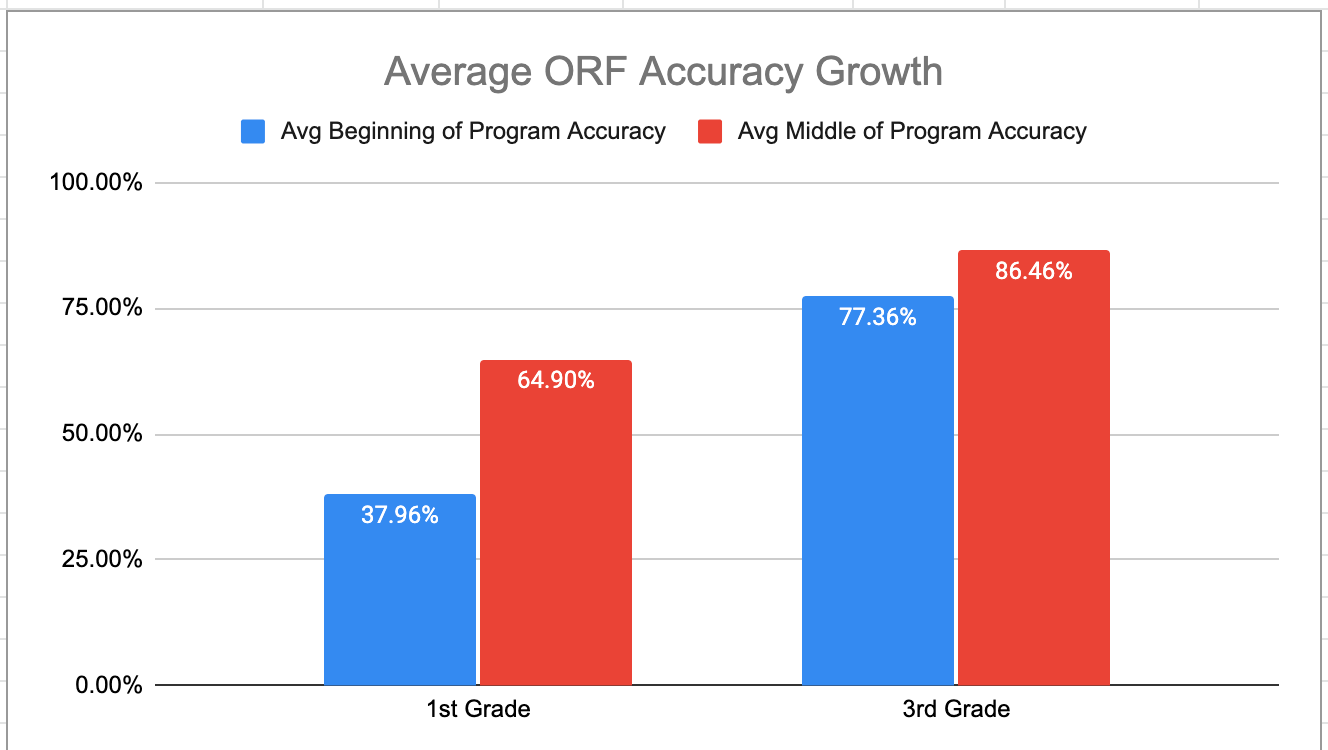
Many first- and third-graders as part of a Ignite Reading pilot at KIPP Bridge Academy in West Oakland, California are making progress, but are still reading below grade level. (Ignite Reading)

Results from a pilot program at Kipp Bridge Academy in West Oakland showed that when tutors began working with the third graders on decoding skills, they responded with 77 percent accuracy on a DIBELS “oral reading fluency” test. After 53 days, their accuracy increased to 86 percent.

Sliwerski called the growth “powerful.”

“It’s changing their identities as readers and undoing the trauma that they brought into the program when they said things like, ‘I’m not a good reader’ and ‘I hate reading,’” she said. “This group of students will not necessarily leave us on grade level, but will leave us as stronger, more accurate decoders.”

The SAT Is Going Digital. Will That Make the Test More Equitable?

ASCD

Are we facing improving the state of education or are we sending the SAT assessment into extinction?

By Daniel Mollenkamp    

Jan 25, 2022

Good read…

The move comes as a growing number of colleges and universities have gone test-optional in admissions, in part because the pandemic made it harder for students to gather safely to take the test, and in some cases out of concern that standardized tests may prevent barriers for some types of students.

The College Board announced today that the SAT will be going fully digital, arguing that the shift will make the test easier to take and administer—and a better fit for today’s students.

Many critics of the test, though, remain skeptical that the changes are meaningful.

Priscilla Rodriguez, vice president of College Readiness Assessments for the College Board, and others affiliated with the design made the case in a call with reporters that the test now offers a “more approachable and less stressful experience” for students and educators, a goal that they say was “at the center” of the new changes.

Among the changes, the exam length has been cut down by an hour, from three to two, with shorter passages about a broader range of topics and one question per reading section. Scores will also be delivered faster. 

Not everything has changed, though. In fact, the core components appear to be much the same. The test will still be scored on a 1,600 point scale, and it will still be administered at a school or test center, College Board says, so students will not be taking it at home. The group did run trials of an at-home version of the SAT early in the pandemic, but it moved away from that idea because it said it “would require three hours of uninterrupted, video-quality internet for each student, which can’t be guaranteed for all.”

The College Board said it had run a successful pilot in November of the digital version it did opt for.

The College Board argues that the new changes will increase the amount of options for schools regarding when and how to administer the exam. “As we move digital, we are going to be able to give each student a unique version of the SAT,” Rodriguez stressed. This increases the security of the exams and affords schools more flexibility in when they offer the test, and increasingly, students take the exam during the school day and so the flexibility will keep the doors of opportunity open to more students, she argued. 

Changing Landscape

Bob Schaeffer, executive director of FairTest, a nonprofit that advocates for making the tests optional, said in a statement today that the SAT’s move to digital is simply a “repackaging” of the SAT that does not appear to seriously address the criticisms of the test’s validity or equity. 

“Shifting an unnecessary, biased, coachable, and poorly predictive multiple-choice exam that few schools currently require from pencil-and-paper delivery to an electronic format does not magically transform it into a more accurate, fairer or valid tool for assessing college readiness,” Schaeffer wrote.

More than 1,800 colleges and universities have test-optional admissions policies today, compared to 1,000 just before the pandemic hit, according to figures from FairTest.

Others have also expressed skepticism.

“The issue was not that the SAT was in paper format… that was not the issue AT ALL,” Tweeted Jennifer Jessie, a longtime SAT tutor. “That has not ever come up in the years I’ve tutored this test.”

Pivoting to Remote Learning: Why It Is Harder in Some States Than Others

By Alyson Klein — January 13, 2022

Education Week

Macy Schulman, left, and Mason Yeoh, both students at Fairfield Warde High School in Connecticut, carry pro-remote learning signs during a rally in August of parents and students fighting to have an online option for school this academic year.
Ned Gerard/Hearst Connecticut Media via AP

The omicron variant is roiling schools across the country, causing widespread teacher shortages, spikes in student absenteeism, and a dearth of school bus drivers.

Superintendents from Vancouver, Wash., to Portland, Maine, have sought to shift at least partly to remote learning to keep instruction going. But some districts are having a much easier time making the pivot than others.

When it comes to the question of who gets to call the shots on a switch back to remote instruction, states have wildly different answers, an Education Week analysis found. Education Week contacted every state education office to determine how states are handling district decisions about transitioning to remote learning. Forty-six states responded.